Best Battery for Your Xterra - The Guide
OEM group sizes for every Nissan Xterra year (24/24F/34R/35), plus AGM vs flooded vs lithium and top picks: Odyssey ODX-AGM34, Optima YellowTop, budget.

Best Battery for Your Nissan Xterra - The Ultimate Guide
The Nissan Xterra is a legendary machine, built for rugged trails and overland adventures far from the beaten path. Whether you're crawling over rocks or just navigating the urban jungle, the last thing you need is a dead battery leaving you stranded. But with a confusing array of terms like "Group 24F," "AGM," and "CCA," choosing the right power source for your rig can feel as challenging as a black-diamond trail.
A battery isn't just a box that starts your engine; it's the heart of your Xterra's electrical system. It powers everything from your headlights and radio to your winch and off-road lights. The factory one is fine for daily driving, but once you start adding accessories or demanding more in extreme weather, an upgrade becomes essential. Making the wrong choice can lead to poor performance, a shorter life, or worse, getting stuck miles from anywhere.
Don't worry - we've got you covered. This comprehensive guide will demystify the world of Nissan Xterra batteries. We'll break down the specific group sizes for every model year, explain the difference between different types, and recommend the absolute best options for every use case, from daily driving and cold-weather starting to full-blown overlanding builds.
Understanding Your Xterra’s Battery Specifications
Before you can pick the best battery, you need to know what fits and what your vehicle was designed for. The Nissan Xterra has used several different battery group sizes and configurations throughout its production run, and understanding these OEM specs is the critical first step in your upgrade journey.
OEM Battery Group Sizes by Generation
The BCI (Battery Council International) group size dictates a battery's physical dimensions, terminal location, and polarity. Using the correct group size ensures a secure fit in the battery tray and that your cables will reach the terminals without modification.
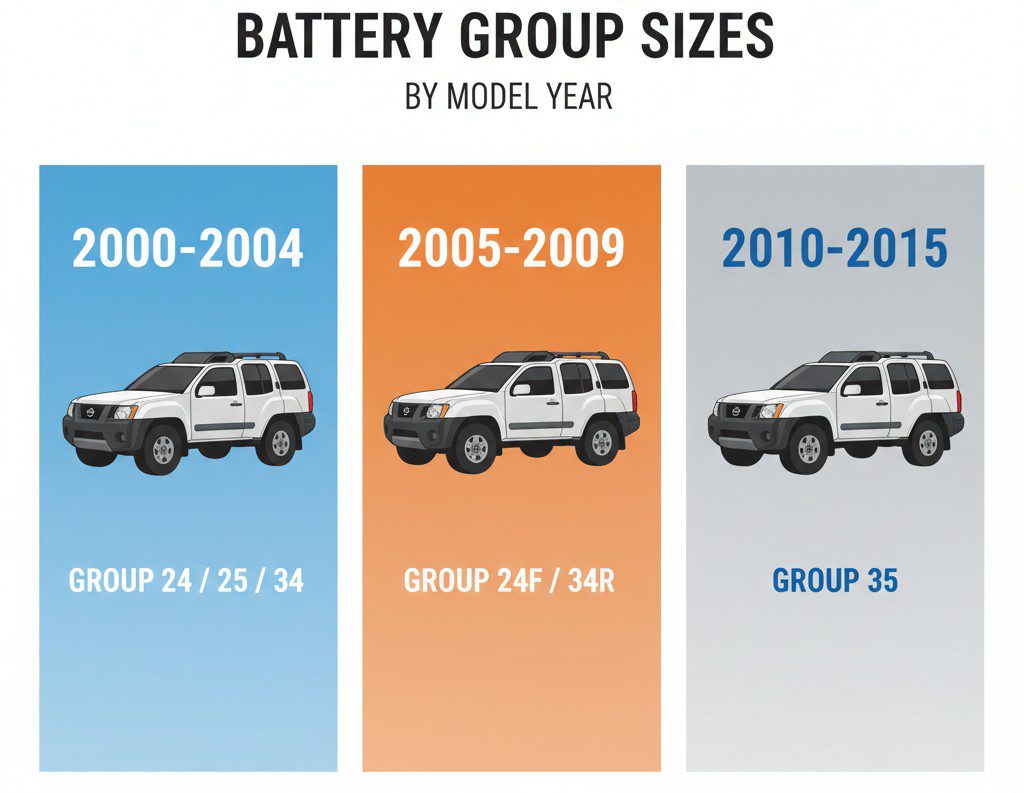
| Model Years | Common BCI Group Size(s) |
|---|---|
| 2000–2004 (First Gen) | Group 24, Group 25, or Group 34 |
| 2005–2009 (Second Gen) | Group 24F or Group 34R |
| 2010–2015 (Second Gen) | Group 35 |
Terminal Layout and Why It Matters
You might see suffixes like "F" or "R" on a battery group size, and these are extremely important. They indicate the terminal polarity. For example:
- Group 34: Positive terminal is on the left.
- Group 34R: The "R" stands for "Reverse," meaning the positive terminal is on the right.
- Group 24F: The "F" also indicates a reversed terminal layout compared to a standard Group 24.
Your Xterra's battery cables are a specific length. Installing with the wrong terminal layout will likely result in cables that are too short to connect, or worse, a dangerous short circuit. Always double-check that your new battery's positive and negative posts match the orientation of your old one.
Factory Alternator Output and Its Limits
Your alternator is responsible for recharging your battery and powering your vehicle's electronics while the engine is running. Most second-generation Xterras (2005-2015) equipped with the 4.0L V6 came with a 110-amp alternator. First-generation models had smaller units, typically around 80-90 amps.
While 110 amps is sufficient for stock applications, it can be pushed to its limit if you're running heavy-draw accessories like a winch, multiple high-powered off-road lights, and a camping fridge simultaneously. For serious builds, many owners upgrade the alternator and perform the "Big 3" wiring upgrade to ensure the electrical system can handle the increased load.
Choosing the Right Battery Type: AGM vs. Flooded vs. Lithium
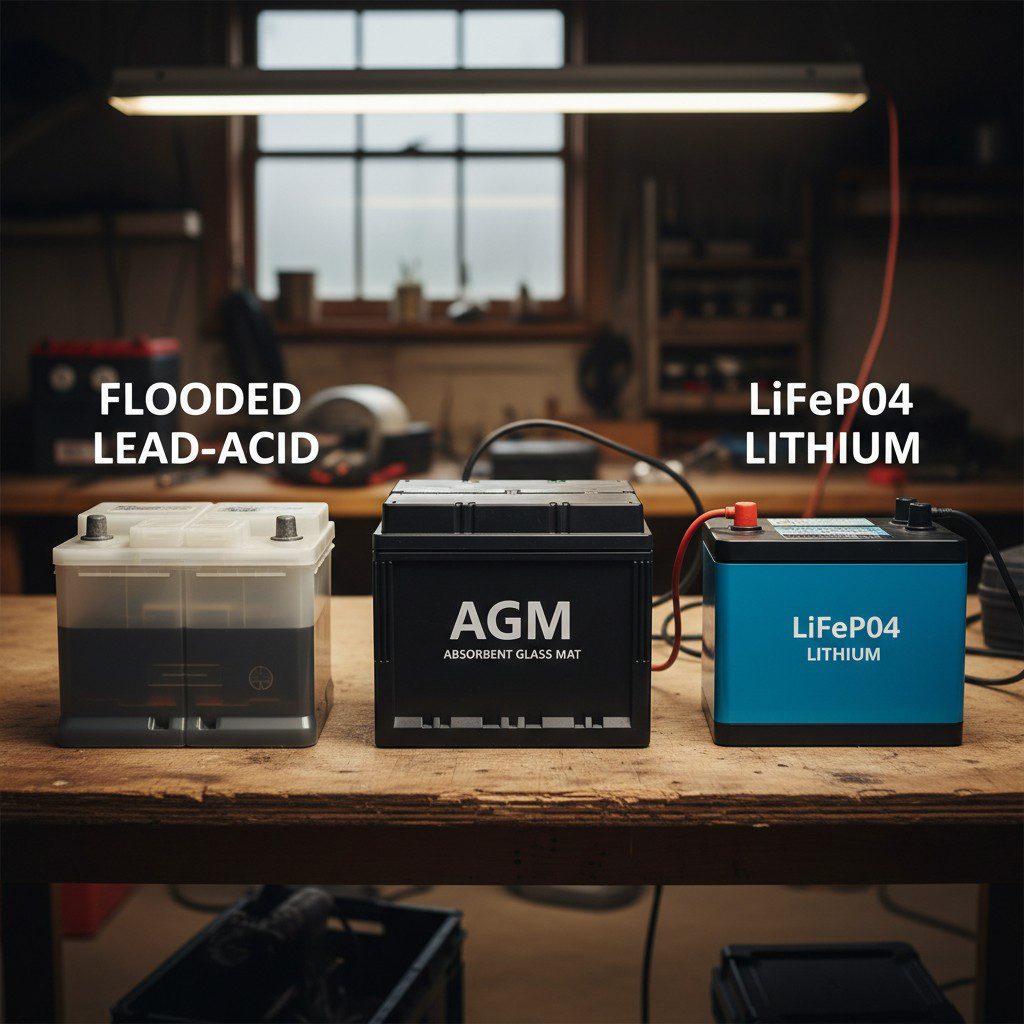
The technology inside is just as important as its size. The three main types you'll encounter are traditional flooded lead-acid, AGM, and the more exotic Lithium Iron Phosphate (LiFePO₄), each with distinct advantages and disadvantages.
Flooded Lead-Acid: The Reliable Standard
This is the traditional, cost-effective car battery you're probably most familiar with.
- Pros: Lowest upfront cost, widely available.
- Cons: Requires periodic maintenance (checking and topping off electrolyte with distilled water), can leak acid if tipped over, and is more susceptible to damage from heavy vibration.
For a stock Xterra used primarily for daily driving, a high-quality flooded battery is a perfectly acceptable and budget-friendly choice.
AGM (Absorbent Glass Mat): The Off-Roader's Choice
AGM batteries are a more advanced form of lead-acid battery and the top choice for most Xterra enthusiasts.
- Pros: Completely sealed and maintenance-free, highly resistant to vibration, won't leak, recharges faster, and offers superior performance in cold weather and deep-cycle applications.
- Cons: Higher cost than flooded batteries.
If you do any off-roading, run high-draw accessories, or live in a cold climate, an AGM battery is the single best upgrade you can make to your Xterra's electrical system.
LiFePO₄ (Lithium): The Lightweight Powerhouse
Lithium batteries are the cutting edge of battery technology, offering incredible performance at a premium price.
- Pros: Extremely lightweight (often less than half the weight of a lead-acid battery), exceptional cycle life (can be drained and recharged thousands of times), and can provide consistent voltage under load.
- Cons: Very expensive, requires a specific charging profile (your stock alternator may not be ideal without modifications), and performance can degrade significantly in freezing temperatures.
For most Xterra owners, a LiFePO₄ battery is overkill for a primary starting battery but is an excellent - albeit pricey - option for a secondary "house" battery in an overlanding setup.
Best Batteries for the Nissan Xterra (Top Picks for Every Need)
Now for the main event. We’ve sifted through the specs and user feedback to identify the top-performing batteries that will keep your Xterra ready for anything.
Top AGM Batteries for Winching & Heavy-Duty Use
These are the workhorses. They deliver massive cranking power for starting and can handle the deep-cycling demands of winches, fridges, and other power-hungry gear.
- Odyssey ODX-AGM34 (PC1500T): The undisputed king of rugged performance. With 850 Cold Cranking Amps (CCA) and a massive 135-minute reserve capacity, this Group 34 battery is built to take a beating and keep going. Its pure lead plate construction gives it an incredible cycle life and rapid recharge capability.
- NorthStar NSB-AGM35: A direct competitor to Odyssey, NorthStar is known for extreme durability and power. This Group 35 battery boasts 740 CCA, a 115-minute reserve capacity, and an outstanding 4-year full replacement warranty, making it a fantastic choice for serious builds.
- Optima YellowTop D34/78: A legendary name in the dual-purpose battery world. The YellowTop is specifically designed to be both a starting battery and a true deep-cycle one. Its 620 CCA is more than enough for starting, and its SpiralCell design provides excellent vibration resistance and cycling capability.
Best for Cold-Weather Starting
When the temperature plummets, you need a battery with the highest possible CCA to turn over that cold 4.0L V6. AGM batteries excel here due to their low internal resistance.
- Optima RedTop 35: Engineered purely for starting power. This Group 35 battery delivers a potent 720 CCA in a relatively lightweight package. Its spiral-cell design is leak-proof and provides some of the best cold-weather performance on the market.
- Odyssey ODX-AGM34: Its class-leading 850 CCA makes it a top contender for cold climates as well. If you need both extreme starting power and deep-cycle capability, this is the one to get.
- DieHard Platinum AGM (Group 24F or 35): A trusted name with modern power. The Platinum AGM line offers high CCA (typically over 700) and a solid 3-year warranty, making it a reliable choice for frosty mornings.
Best Value for Daily Driving
If your Xterra is primarily a daily driver or sees only light trail duty, you don't need to break the bank. These batteries offer excellent reliability and performance for the price.
- Duralast Gold 24F-DLG: Often considered an OEM-quality equivalent, this flooded battery provides a strong 750 CCA and a 130-minute reserve capacity. With a 3-year free replacement warranty, it's one of the best bangs for your buck.
- Interstate MTP-24F: Another rock-solid flooded option from a brand known for quality. It typically features around 750 CCA and comes with a 30-month warranty and nationwide service network.
Upgrades for Serious Off-Road and Overlanding Rigs
If your Xterra is loaded with accessories, the stock electrical system will eventually become a bottleneck. To reliably power your adventures, you'll need to look beyond just the battery.
Powering High-Draw Accessories
A single battery can be quickly overwhelmed by a winch pull or by running a fridge and lights all weekend. This is where dual-battery systems come in. A typical setup involves:
- A primary starting battery: Usually an AGM in the stock location.
- An auxiliary "house" battery: A deep-cycle AGM or LiFePO₄ battery to power accessories.
- A battery isolator or DC-to-DC charger: A smart device that separates the two batteries, ensuring your accessories can't drain your starting battery, but allows the alternator to charge both.
The "Big 3" Wiring Upgrade Explained
This is a foundational electrical upgrade for any modified vehicle. It involves replacing three key cables in your charging system with much heavier gauge wire (typically 0 or 1/0 gauge):
- Alternator positive to battery positive
- Battery negative to chassis ground
- Engine block to chassis ground
This simple upgrade reduces voltage drop, allowing your alternator to charge your battery more efficiently and delivering more consistent power to all your electronics.
Tips & Tricks for Xterra Battery Health
- Use a Trickle Charger: If your Xterra sits for weeks at a time, connect it to a multi-stage smart charger. This prevents it from slowly discharging and sulfating, which dramatically shortens its life.
- Keep It Clean and Tight: Corrosion on battery terminals acts as an insulator, preventing a good connection. Clean them periodically with a wire brush and a baking soda/water solution. Ensure the terminal clamps and the battery hold-down bracket are snug. A vibrating battery will fail prematurely.
- Invest in a Memory Saver: When you disconnect your battery, your Xterra's Engine Control Unit (ECU) and radio presets are erased. A simple memory saver that plugs into your OBD-II or 12V power port will keep these systems powered during the swap.
- Practice Safe Jump-Starting: Always connect the cables in the correct order to prevent dangerous sparks.
Safe Jump-Starting Procedure:
- Connect the red (positive) clamp to the positive terminal of the dead battery.
- Connect the other red (positive) clamp to the positive terminal of the good battery.
- Connect the black (negative) clamp to the negative terminal of the good battery.
- Crucially, connect the final black (negative) clamp to a clean, unpainted metal surface on the engine block or frame of the dead vehicle, away from the battery.
- Start the good vehicle, then start the dead vehicle. Remove cables in the reverse order.
FAQ - Nissan Xterra batteries
- What battery group size does my Nissan Xterra use?
It depends on the model year: 2000–2004 use Group 24/25/34, 2005–2009 use Group 24F/34R, and 2010–2015 use Group 35. - What’s the difference between AGM, flooded, and lithium batteries?
Flooded: standard, cheapest, needs maintenance. AGM: sealed, maintenance-free, better for off-road/vibration/cold climates. Lithium (LiFePO₄): lightest, longest-life, most expensive, not always ideal for stock Xterra charging systems. - Which battery type is best for off-roading?
AGM batteries are the top pick due to their ruggedness, vibration resistance, and maintenance-free design. - How do I know if a battery will fit my Xterra?
Look for the correct BCI group size and make sure the terminal layout (standard, F, or R) matches your cable arrangement. - What is cold cranking amps (CCA) and how much do I need?
CCA measures a battery’s starting power in cold temperatures. Higher CCA (e.g., above 700) is ideal for cold climates. - Do I need to upgrade my alternator for a bigger or dual-battery setup?
If you add high-draw accessories (winch, fridge, lights), consider upgrading your alternator (stock is 110A for Gen 2) and performing the “Big 3” wiring upgrade. - What’s the best battery for daily driving my Xterra?
High-quality flooded or AGM batteries like the Duralast Gold 24F-DLG, Interstate MTP-24F, or DieHard Platinum AGM provide great reliability and value. - How can I keep my Xterra’s battery healthy?
Use a trickle charger if the vehicle sits, clean terminals, keep clamps/tie-downs tight, and use a memory saver during swaps. - What’s the safest way to jump-start my Xterra?
Connect positive clamps first (dead, then good), then negative to the good battery, and last negative to a metal ground away from the battery on the dead vehicle. - Should I get a dual-battery setup?
If you regularly run accessories while parked or overland/camp, a dual setup (one AGM starter, one deep-cycle or lithium house battery) with an isolator or DC-DC charger is best for reliability.
Conclusion: Powering Your Next Adventure
Choosing the right battery for your Nissan Xterra is a critical decision that directly impacts its reliability and capability. By understanding your vehicle's specific needs and matching them with the right battery technology, you can ensure you have the power you need, whether you're starting up on a frozen morning or winching yourself out of a tough spot on the trail.
For most owners who use their Xterra for a mix of daily driving and weekend adventures, an AGM battery offers the perfect blend of power, durability, and maintenance-free convenience. If you're building a serious overland rig, pairing a high-quality AGM starting battery with a dedicated deep-cycle auxiliary battery and a "Big 3" wiring upgrade will create an electrical system that's as tough as your truck.
Now it’s time to take the next step. Assess how you use your Xterra, check the group size of your current battery, and use our recommendations to make an informed purchase. Investing in a great battery isn't an expense - it's cheap insurance that guarantees your adventures never end with a call for a jump-start.