Best Brake Pads and Rotors for Xterra
Ceramic vs semi-metallic pads and blank vs slotted rotors for the Nissan Xterra, with top picks for daily (Akebono ProACT), towing, off-road, and budget.

Best Brake Pads and Rotors for Nissan Xterra (Daily, Towing, & Off‑Road)
The Nissan Xterra is a legend in the off-road and overlanding community, known for its rugged, no-nonsense capability. Whether you're navigating city streets, towing a trailer up a mountain pass, or tackling a remote trail, your confidence is directly tied to your vehicle's ability to stop. While the factory brakes are adequate for general use, upgrading your pads and rotors is one of the most effective ways to enhance safety, performance, and durability for your specific driving needs.
Choosing the right components can feel overwhelming. With a sea of options ranging from low-dust ceramic pads to aggressive semi-metallic compounds and from plain-faced rotors to complex slotted designs, how do you know what's best? This guide cuts through the noise. We'll break down the key differences between Xterra generations, compare the most popular pad materials, and provide our top picks for every application—from the daily commute to the most demanding off-road adventures.
Get ready to transform your Xterra's stopping power. This comprehensive guide will give you the knowledge to select the perfect brake setup, ensuring you have the control and confidence you need, no matter where the road (or trail) takes you.
Understanding Your Xterra's Brakes: 1st Gen vs. 2nd Gen
Before you start shopping for an Xterra brake upgrade, it's crucial to know which generation you own. The braking systems on the first and second-generation Xterras are fundamentally different, with unique rotor sizes, caliper designs, and pad shapes. Ordering parts for the wrong year is a common and frustrating mistake, so confirming your vehicle's details is the essential first step.
1st Generation Xterra (2000–2004)
The first-gen Xterra, powered by the 3.3L VG33E engine, features a solid and reliable brake system for its time. The front brakes do the majority of the work, equipped with vented rotors to help manage heat during stops.
- Front Rotors: Approximately 283mm x 28mm (11.14" x 1.10"), vented
- Rear Brakes: Typically feature a drum-in-disc setup or a slightly thinner vented disc rotor.
- Brake Fluid: Standard DOT 3 fluid is specified from the factory.
2nd Generation Xterra (2005–2015)
The second-gen Xterra received a significant power boost with the 4.0L VQ40 engine, and its braking system was upgraded to match. It features larger rotors on both the front and rear axles for improved heat dissipation and stopping power, essential for the heavier and more powerful vehicle.
- Front Rotors: Increased to approximately 296mm x 28mm (11.65" x 1.10"), vented
- Rear Rotors: A robust 286mm x 18mm (11.26" x 0.71"), vented
- Brake Fluid: Standard DOT 3 fluid is specified from the factory.
- Note: The Pro-4X off-road models use the same core brake hardware but may have included more aggressive factory pads.
| Feature | 1st Gen Xterra (2000–2004) | 2nd Gen Xterra (2005–2015) |
|---|---|---|
| Front Rotor Size | ~283mm x 28mm | ~296mm x 28mm |
| Rear Rotor Size | ~283mm x 18-20mm | ~286mm x 18mm |
| Brake Fluid Spec | DOT 3 | DOT 3 |
| Compatibility | Parts DO NOT interchange with 2nd Gen | Parts DO NOT interchange with 1st Gen |
Brake Pad Showdown: Ceramic vs. Semi-Metallic
The single most impactful choice you'll make during your brake job is the pad material. The compound used in a brake pad dictates its performance characteristics, including noise, dust, stopping power, and fade resistance. For your Xterra, the choice primarily comes down to two main types: ceramic and semi-metallic.
Ceramic Brake Pads: The Quiet Commuter
Ceramic pads are engineered for smooth, quiet, and clean operation. Made from dense ceramic fibers and non-ferrous filler materials, they are the ideal choice for a daily driven Xterra that spends most of its time on paved roads.
- Pros:
- Extremely Low Dust: They produce a light-colored, fine dust that doesn't stick to wheels.
- Quiet Operation: Designed to eliminate squeal and brake noise.
- Long Rotor Life: The non-abrasive compound is gentle on your brake rotors.
- Cons:
- Softer Initial "Bite": Can feel less aggressive on the initial pedal press.
- Lower Heat Tolerance: Not ideal for heavy towing or aggressive mountain descents where brake fade is a concern.
Semi-Metallic Brake Pads: The Heavy-Duty Hauler
Semi-metallic pads contain a high percentage of steel fibers, giving them incredible strength and heat conductivity. This makes them the go-to choice for trucks and SUVs that work hard, whether it's towing, hauling heavy loads, or spirited driving.
- Pros:
- Excellent Heat Fade Resistance: They dissipate heat quickly, providing consistent performance under load.
- Strong Initial Bite: Offer a firm, confident pedal feel.
- Great All-Weather Performance: Perform reliably in a wide range of temperatures.
- Cons:
- More Brake Dust: Tend to produce more dark, noticeable dust.
- Can Be Noisier: The metallic content can sometimes lead to more squeal or grinding sounds.
- Harsher on Rotors: The aggressive compound can wear rotors out more quickly than ceramic pads.
Carbon-Fiber Ceramic: The Best of Both Worlds?
A newer category of hybrid pads, often called carbon-fiber ceramic, aims to deliver the benefits of both materials. Brands like PowerStop have pioneered these formulas, which are designed specifically for trucks and 4x4s. They offer the high-temperature fade resistance needed for towing but with the low-dust and low-noise characteristics of a premium ceramic pad.
Top Brake Pads & Rotors for Every Xterra Owner
Now that you understand the fundamentals, let's dive into the best brake pads and rotors for your Nissan Xterra based on your specific use case. Each recommendation is tailored to provide the optimal balance of performance, durability, and value.
Best for the Daily Driver (Low Dust & Quiet Operation)
For the Xterra that serves as a daily commuter or family hauler, your priorities are comfort, cleanliness, and reliability. A premium ceramic pad paired with a quality coated rotor is the perfect combination.
- Recommended Pads: Akebono ProACT or Wagner ThermoQuiet Ceramic Pads.
- Recommended Rotors: Coated OEM-style rotors from brands like Centric or Bosch QuietCast.
- Why It's a Great Choice: This setup delivers smooth, silent stops with almost no visible brake dust on your wheels. The rotor coating prevents rust on the hub and vents, keeping them looking great for years. It's a true "install it and forget it" solution for everyday driving.
Best for Towing & Heavy-Duty Use (Maximum Stopping Power)
If you use your Xterra to tow a boat, trailer, or haul heavy gear, you need a brake system that can handle extreme heat without fading. A heavy-duty pad formula is non-negotiable here.
- Recommended Pads: PowerStop Z36 Truck & Tow (Carbon-Fiber Ceramic) or EBC Yellowstuff (Semi-Metallic).
- Recommended Rotors: High-quality blank vented rotors or performance slotted rotors.
- Why It's a Great Choice: The PowerStop Z36 pads are specifically engineered for the high thermal loads of towing, offering fade-free performance without excessive noise or dust. Paired with slotted rotors, which help vent hot gases from the pad surface, this combination provides the ultimate in confident, repeatable stopping power when you need it most.
Best for Off-Road & Overlanding (Durability & Reliability)
The trail demands durability above all else. Your brake system needs to withstand mud, water, dust, and impacts while providing reliable performance on steep descents.
- Recommended Pads: EBC Greenstuff (Kevlar/Aramid Fiber) or Hawk LTS (Light Truck & SUV).
- Recommended Rotors: High-quality, corrosion-resistant coated blank rotors.
- Why It's a Great Choice: Kevlar-based pads like EBC Greenstuff offer a strong bite and handle contamination from dirt and moisture well. It's critical to pair them with robust, fully coated rotors. Avoid cross-drilled rotors for off-roading, as the holes can trap debris and become stress points, leading to cracks under harsh conditions.
Best for Street Performance (Enhanced Bite & Fade Resistance)
For the Xterra owner who enjoys spirited driving and wants a more responsive pedal feel, a performance street pad matched with slotted rotors is the ideal upgrade.
- Recommended Pads: Hawk HPS (High Performance Street) or EBC Redstuff.
- Recommended Rotors: EBC USR Slotted Rotors or StopTech Slotted Sport Rotors.
- Why It's a Great Choice: This combination significantly improves initial bite and heat management. The slots on the rotor surface constantly clean and de-gas the brake pad, preventing the brake fade that can occur during repeated hard stops. It's the perfect setup for a modified Xterra that sees enthusiastic street use.
Best Budget-Friendly OEM Replacement
If you simply need to get your Xterra back on the road with reliable, safe brakes without breaking the bank, quality OEM-equivalent parts are an excellent choice.
- Recommended Pads: Centric OEM+ Ceramic or Wagner OEX.
- Recommended Rotors: Standard vented rotors from Centric or other reputable aftermarket suppliers.
- Why It's a Great Choice: These parts are designed to meet or exceed original factory specifications. You'll get predictable, quiet performance that restores your Xterra's braking to like-new condition at a fraction of the cost of dealer parts.
Choosing the Right Rotors: Blank vs. Slotted vs. Drilled
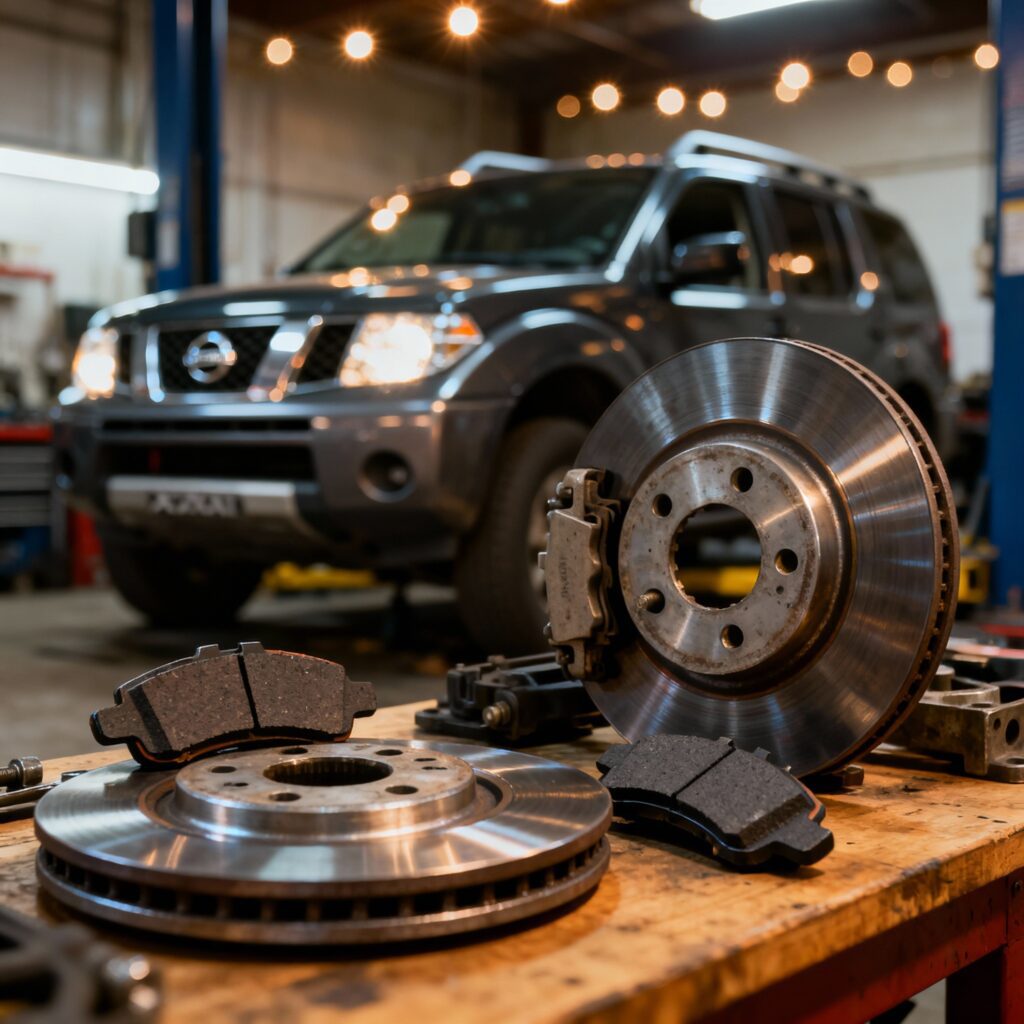
The rotors are the other half of the braking equation. While all Xterra rotors are vented (meaning they have internal fins to help with cooling), the design of the rotor face can also impact performance.
- Blank Rotors: These are the standard, smooth-faced rotors that come from the factory. They offer the largest surface area for heat absorption and are perfect for daily driving and most off-road applications. For best results, choose a set with a full anti-corrosion coating.
- Slotted Rotors: These rotors have channels machined into the face. The slots help wipe away gas, water, and debris from between the pad and rotor, which improves initial bite and helps prevent brake fade under heavy use. They are an excellent upgrade for towing and performance street driving.
- Drilled & Slotted Rotors: These rotors add cross-drilled holes to the slotted design. While they offer a cosmetic appeal and can help with cooling, the holes remove material and can become stress points. We do not recommend fully drilled rotors for any Xterra that will see heavy towing or off-road use, as they are more prone to cracking under extreme thermal stress.
Essential Installation & Maintenance Guide
Choosing the right parts is only half the battle; proper installation is key to safe and effective braking. A successful brake job involves more than just swapping pads and rotors. Paying attention to the details will ensure a quiet, long-lasting result.
The Critical Step: Bedding-In Your New Brakes
Properly "bedding" or "burnishing" your new pads and rotors is the most important—and most often skipped—step. This process deposits an even layer of friction material onto the rotor surface, ensuring smooth, powerful, and quiet stops for the life of the brakes.
- Find a safe, open area with no traffic.
- Perform ~20 moderate stops from about 30 mph down to 5 mph.
- Do not come to a complete stop during the process. Accelerate back up to speed immediately after each slowdown.
- Allow approximately 30 seconds of driving between stops for the brakes to cool slightly.
- After the last stop, drive for several minutes without using the brakes to allow them to cool down completely.
- Avoid hard, panic stops for the first few hundred miles.
Don't Forget the Supporting Hardware
To prevent noise and ensure proper caliper function, it's wise to service or replace the supporting hardware during your brake job.
- Caliper Slide Pins: Clean and re-lubricate the slide pins with high-temperature synthetic silicone brake grease. If they are corroded or stuck, replace them.
- Anti-Rattle Clips & Shims: New pads should come with new shims. Always install new anti-rattle clips (hardware kits) to prevent clunks and squeals.
- Braided Steel Brake Lines: For the ultimate in pedal feel, especially for off-roading or towing, consider upgrading the factory rubber lines to stainless steel braided lines. They prevent hose expansion under pressure, resulting in a firmer, more responsive pedal.
Key Torque Specs for Your Xterra
Using a torque wrench is not optional—it's essential for safety. Over-tightening can warp rotors, while under-tightening can lead to catastrophic failure.
Important Torque Values:
- Wheel Lug Nuts: 98 ft-lb
- Caliper Guide Pin Bolts: ~25–35 ft-lb
- Caliper Bracket Bolts: ~80–100 ft-lb
Always verify these values with a factory service manual for your specific year and model.
Brake Fluid 101: DOT 3 vs. DOT 4 for Your Xterra
Your brake fluid is the lifeblood of the system, yet it's often neglected. Nissan specifies DOT 3 brake fluid for all Xterra models, which is perfectly adequate for normal driving. However, for more demanding use, an upgrade might be worth considering.
- DOT 3 Fluid: This is the factory standard. It has a lower boiling point than DOT 4.
- DOT 4 Fluid: This fluid has higher dry and wet boiling points, meaning it can withstand more heat before it boils and causes brake fade. This makes it an excellent, simple upgrade for any Xterra used for towing, mountain driving, or performance applications.
Regardless of the type, brake fluid should be flushed and replaced every 2 years, as it absorbs moisture over time, which lowers its boiling point and can corrode internal components. When bleeding the system, follow the proper sequence, which is typically starting with the wheel farthest from the master cylinder: Right Rear → Left Rear → Right Front → Left Front.
Tips & Tricks for a Perfect Xterra Brake Job
- Tip 1: Banish Brake Judder. If you feel a pulsation or vibration through the steering wheel when braking, it's likely caused by uneven pad deposits on the rotors, not "warped" rotors. For mild cases, you can sometimes clean the rotor surface with a wire brush or fine-grit sandpaper and then re-bed the pads to lay down a fresh, even layer of friction material.
- Tip 2: Deal with the Rotor Set Screw. Many Nissan rotors have a small Phillips head screw that holds the rotor to the hub. These are often rusted in place and easily stripped. Don't panic! This screw is only there for the assembly line. If it's stuck, you can drill it out or simply leave it off—your wheel and lug nuts are what actually hold the rotor on.
- Tip 3: Safety First, Always. Never work on a vehicle supported only by a jack. Use quality jack stands placed on a solid frame rail or crossmember. Always chock the wheels on the opposite end of the vehicle to prevent it from rolling.
- Tip 4: Double-Check Your Fitment. The differences between the 1st and 2nd generation Xterra are significant. Before you even open the boxes, hold the new rotor up to the old one to confirm the diameter and bolt pattern match. The same goes for the brake pads—confirm the shape is identical.
FAQ - Xterra Brake Pads and Rotors
- Q: What’s the main difference between 1st and 2nd generation Nissan Xterra brakes?
A: 1st and 2nd gen Xterras use different rotor sizes, caliper designs, and pad shapes—parts are not interchangeable and must match your vehicle’s year. - Q: Are ceramic or semi-metallic brake pads better for daily driving?
A: Ceramic pads are preferred for daily driving thanks to quiet operation and low dust, while semi-metallic are better for heavy loads or harsh use. - Q: What brake pads and rotors are best for towing or heavy-duty use?
A: For heavy loads, use heavy-duty pads (like PowerStop Z36 or EBC Yellowstuff) with slotted or high-quality vented rotors for optimal heat dissipation. - Q: Can I use drilled rotors for off-road driving?
A: Drilled rotors are not recommended—mud and debris can get trapped in the holes, possibly leading to cracks; use coated blank rotors instead. - Q: How important is it to “bed-in” new pads and rotors?
A: Bedding-in is critical for even friction material transfer and long-lasting, quiet, and effective braking. - Q: What type of brake fluid should I use in my Xterra?
A: DOT 3 is standard, but DOT 4 is a good upgrade for towing, mountains, or performance use due to higher boiling points. - Q: How often should brake fluid be changed?
A: Brake fluid should be flushed and replaced every 2 years, as it absorbs moisture which can reduce performance and cause corrosion. - Q: What are the main signs your rotors or pads need replacing?
A: Signs include squeaking, grinding, reduced stopping power, vibrations, or a brake warning light. - Q: What torque specs should I use when installing brakes on an Xterra?
A: Wheel lug nuts: 98 ft-lb, caliper guide pin bolts: ~25–35 ft-lb, caliper bracket bolts: ~80–100 ft-lb (always check your service manual). - Q: Do I need to replace supporting hardware during a brake job?
A: Yes—replace or service caliper slide pins, anti-rattle clips, and shims to prevent noise and ensure proper caliper function.
Conclusion: Stop with Confidence
Upgrading the brake pads and rotors on your Nissan Xterra is one of the most rewarding and impactful improvements you can make. It's a project that directly enhances your vehicle's safety and tailors its performance to your unique lifestyle. By moving beyond the one-size-fits-all factory setup, you gain the stopping power and durability needed to tackle any challenge with confidence.
Remember the golden rule: choose your components based on how you actually use your truck. A quiet, low-dust ceramic setup is perfect for the daily grind, while a robust semi-metallic or carbon-ceramic system is essential for the demands of towing and off-roading. No matter which path you choose, never underestimate the importance of meticulous installation—from cleaning and lubricating hardware to properly bedding-in the new components.
You now have the expert knowledge to make an informed decision and equip your Xterra with the best brake pads and rotors for your needs. Take your time, choose wisely, and enjoy the peace of mind that comes with having absolute control over your capable machine.