Best Radiator for Xterra: Cooling & SMOD Prevention Guide
The SMOD risk on 2005-2010 Nissan Xterras, compared replacement radiators (Denso 221-3409, CSF 7029, Mishimoto Pro-Series), plus the full bypass method.

Best Radiator for Nissan Xterra: Cooling & SMOD Prevention Guide
The Nissan Xterra is a legendary off-road warrior, known for its rugged capability and no-nonsense design. Whether you're crawling over rocks or commuting to work, its V6 engine needs a reliable cooling system to perform at its best. However, a notorious factory flaw in certain models can lead to catastrophic transmission failure, making a radiator replacement not just a maintenance task, but a critical, preventative upgrade.
This issue, infamously known as the "Strawberry Milkshake of Death" or SMOD, stems from a faulty internal transmission cooler. When it fails, coolant and transmission fluid mix, creating a destructive pink sludge that can destroy your transmission in a heartbeat. Don't worry - this guide is here to help. We'll break down everything you need to know, from understanding the SMOD problem to choosing the absolute best radiator for your Xterra, no matter how you use it.
We've done the research, compared the top brands, and compiled a list of the best OEM replacements, heavy-duty upgrades, and budget-friendly options. Let's dive in and find the perfect cooling solution to keep your Xterra running strong for years to come.
Understanding the Nissan Xterra's Stock Cooling System
Before choosing an upgrade, it's essential to understand the factory setup and the key differences between the Xterra's two generations. The original design choices by Nissan directly impact which replacement radiator you'll need and why certain models are prone to failure.
Generation 1 (2000–2004) Radiator Specs
The first-generation Xterra, equipped with either the 2.4L four-cylinder or the 3.3L V6 (VG33E), used a relatively straightforward cooling system. These models featured a single-row aluminum core radiator, approximately 25mm thick, with plastic end tanks. On automatic transmission models, a small ATF cooler was integrated into the radiator. Manual transmission versions either had no cooler or a slightly thicker core to compensate. Critically, these early models are not susceptible to the SMOD issue that plagues the second generation.
Generation 2 (2005–2015) Radiator Specs
The second-generation Xterra came exclusively with the powerful 4.0L V6 (VQ40DE) engine and an automatic transmission. Nissan used a larger, down-flow radiator with a core thickness of around 36.5mm to handle the increased heat. Unfortunately, the Calsonic-made radiators used from 2005 to 2010 contained a critical design flaw in the internal transmission fluid cooler, which is the direct cause of SMOD. Later models (post-2010) featured an updated design, but the risk remains a major concern for any owner of a 2005-2010 model.
The Elephant in the Room: SMOD (Strawberry Milkshake of Death)
If you own a second-gen Xterra, you've likely heard whispers of SMOD. This isn't just a quirky nickname; it's a serious mechanical failure that can cost you thousands in transmission repairs. Understanding this issue is the single most important factor when considering a radiator replacement.
The SMOD failure occurs when the internal automatic transmission fluid (ATF) cooler inside the radiator cracks. The engine's cooling system operates at a higher pressure (around 15 psi) than the transmission fluid circuit. This pressure difference forces engine coolant into the transmission, creating a pink, milky emulsion that looks like a strawberry milkshake. This contaminated fluid quickly destroys the transmission's clutches, seals, and solenoids.
Critical Warning: Early symptoms of SMOD include milky pink fluid on your transmission dipstick or in your coolant overflow reservoir. If you see this, stop driving immediately. You may be able to save the transmission with a complete fluid flush and a new radiator, but continued driving will almost certainly lead to total transmission failure.
The most effective way to prevent SMOD is to completely bypass the radiator's internal cooler and install a dedicated external transmission cooler. This eliminates any possibility of cross-contamination.
The Best Nissan Xterra Radiators for Every Need
Choosing the right radiator depends entirely on your budget, your driving habits, and your tolerance for risk. We've broken down our top picks into four distinct categories to help you find the perfect match for your Xterra.
| Category | Best For | Key Features | Price Range |
|---|---|---|---|
| OEM-Style Replacement | Daily driving, stock performance | Plastic/aluminum, direct fit, includes ATF cooler | $100 - $450 |
| All-Aluminum Heavy-Duty | Towing, performance, SMOD prevention | Fully welded, 2-row core, superior cooling | $350 - $450 |
| Off-Road & Overlanding | Extreme conditions, low-speed crawling | Kits with hoses, thermostats, external coolers | $400+ |
| Budget-Friendly | Getting back on the road cheaply | Basic 1-row, plastic tanks, mixed reliability | $80 - $150 |
Best OEM-Style Replacement Radiators
These are direct, drop-in replacements for your factory radiator. They are ideal for daily drivers who aren't pushing their vehicles to the limit and want a straightforward, reliable solution.
- Denso 221-3409: This is a premium OEM-style replacement for 2005-2010 V6 models. It features a high-efficiency 36.5mm all-aluminum core and an integrated concentric tube cooler that is a significant improvement over the original design. It's a top choice for a stock-plus upgrade.
- Nissan OEM Radiator (PN 21460-9CA0E): For those who want the guaranteed fit and finish of a factory part, the genuine Nissan radiator is the way to go. It features the updated post-2010 design, which is less prone to SMOD, but the risk is not entirely eliminated.
- Spectra Premium / Four Seasons: These aftermarket brands offer OEM-equivalent radiators at a much lower price point. They are typically single-row, plastic/aluminum units that get the job done for standard use, but may not offer the longevity of a Denso or Nissan part.
Best All-Aluminum Heavy-Duty Radiators
For those who tow, off-road, or simply want the best possible cooling performance and SMOD-proof durability, an all-aluminum radiator is a must-have upgrade. These units eliminate the failure-prone plastic end tanks and often feature larger, multi-row cores.
- CSF 7029: A top pick among Xterra enthusiasts, the CSF 7029 is a 2-row, all-aluminum, fully welded radiator that drops right in. It offers a significant improvement in heat rejection (around 30%) and completely eliminates the risk of cracked plastic tanks.
- Mishimoto Pro-Series: Mishimoto is a leader in performance cooling. Their all-aluminum radiators for the Xterra often boast a 30% increase in core volume and are built to handle extreme abuse. They come with a lifetime warranty, offering peace of mind.
- Koyorad: Known for their racing-grade construction, Koyorad offers high-flow, 2-row aluminum radiators that are incredibly durable. While sometimes harder to find, they are a premium choice for those demanding the absolute best in cooling performance.
Best Off-Road & Overlanding Cooling Upgrades
When you're crawling at low speeds in hot weather, airflow is minimal, and your cooling system is pushed to its limits. These kits and components are designed for the most demanding off-road scenarios.
- Z1 Off-Road Cooling Kit: This comprehensive kit bundles a high-quality CSF dual-row radiator with durable silicone hoses and a lower-temperature thermostat. The 170°F thermostat allows the cooling system to activate sooner, keeping engine temperatures in check during slow, high-load situations like rock crawling.
- Derale or Hayden External Transmission Cooler: This isn't a radiator, but it's a crucial upgrade for any automatic Xterra, especially those used for towing or off-roading. Installing a 12-14 row plate-style cooler in front of your condenser and bypassing the radiator's internal cooler completely eliminates the risk of SMOD and dramatically lowers ATF temperatures.
- High-Flow Electric Fan Shroud: At crawl speeds, the stock mechanical fan can struggle. Upgrading to a high-flow electric fan setup from a brand like Mishimoto ensures you have maximum airflow through the radiator core, even when you're standing still.
Best Budget-Friendly Radiators
If your primary concern is getting your Xterra back on the road without breaking the bank, these options provide a functional replacement at an affordable price.
- Spectra / Carter Economy Models: These brands offer the most affordable radiators on the market. They are basic, single-row, plastic-tanked units that will function for daily driving. However, quality can be inconsistent, and they should not be considered a long-term or heavy-duty solution.
- OER Brands (e.g., Four Seasons): Similar to Spectra, these brands provide inexpensive OEM-fit radiators. They usually come with a limited one-year warranty and are best suited for light use in moderate climates.
A Critical Decision: To Bypass or Not to Bypass the Transmission Cooler
For any owner of a 2005-2015 automatic Xterra, the most important decision is how to handle the transmission cooler. Simply replacing the radiator with a new one - even a high-quality unit - does not eliminate the risk of SMOD, as the new radiator still has an internal cooler that could fail.
There are two primary strategies:
- Full Bypass with External Cooler: This is the safest and most recommended method. You disconnect the transmission cooler lines from the radiator and route them to a new, dedicated external cooler mounted in front of the A/C condenser. The ports on the radiator are plugged.
- Pros: 100% eliminates the risk of SMOD. Often provides superior transmission cooling.
- Cons: Requires purchasing an additional part and slightly more complex installation.
- External Cooler in Series: In this setup, you run the transmission fluid from the transmission, through the new external cooler first, and then through the radiator's internal cooler before it returns to the transmission.
- Pros: Provides maximum cooling potential, which can be beneficial for heavy towing in extreme heat.
- Cons: Does not eliminate the risk of SMOD, as the internal cooler is still part of the system.
Our Recommendation: For 99% of Xterra owners, the full bypass method is the definitive solution. It provides excellent transmission cooling while permanently solving the SMOD problem.
Installation Tips & Maintenance Best Practices
Installing a new radiator is a manageable DIY job for those with some mechanical experience. Follow these tips for a smooth and successful installation.
- Torque Specs are Key: Do not overtighten bolts, especially on plastic components. Use a torque wrench.
- Radiator Upper Brackets: 4–5 ft-lb
- Fan Shroud & Fan Clutch Bolts: 7–10 ft-lb
- Proper Coolant Fill & Bleed: After installation, fill the system with Nissan "blue" Long Life Coolant. To bleed air from the system, leave the radiator cap off, turn the heater on high, and let the engine run until it reaches operating temperature. Top off the coolant as air bubbles escape. An air pocket can cause overheating.
- Inspect Hoses and Caps: This is the perfect time to replace your radiator and heater hoses if they are cracked, soft, or bulging. Also, inspect your radiator cap. Gen 1 Xterras use a flat, non-pressurized cap on the radiator itself, while Gen 2 models use a spring-loaded cap. A weak cap can lower the boiling point of your coolant and cause overheating.
- Dispose of Coolant Safely: Used coolant is toxic. Collect it in a sealed container and take it to an auto parts store or a local hazardous waste disposal facility.
Tips & Tricks for Your Radiator Replacement
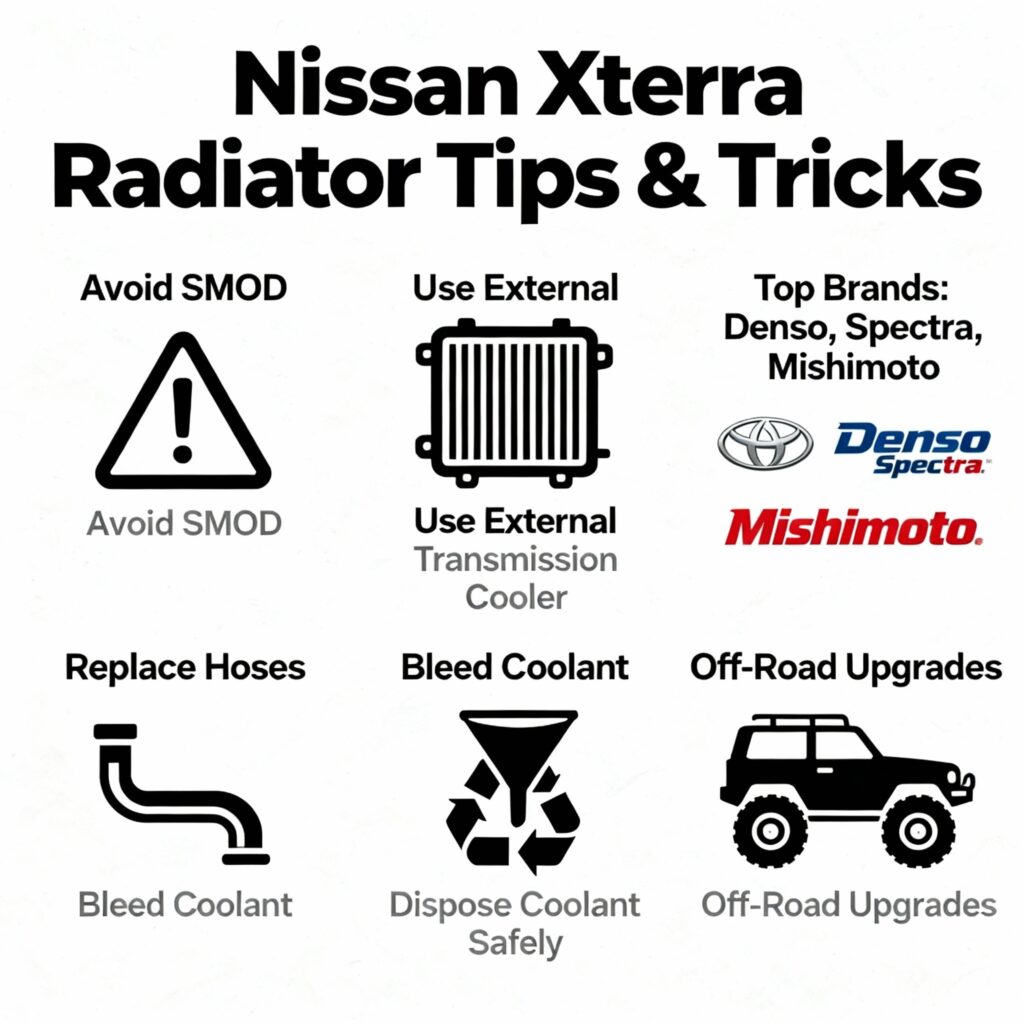
Here are a few extra pointers to make your project a success:
- Pre-Install Flushing: Before installing your brand-new radiator, consider running a cooling system flush through your engine block and heater core with the old radiator still in place. This will clear out any old sediment or rust that could clog your new radiator's delicate fins.
- Bleed the System Like a Pro: To make bleeding easier, park your Xterra on an incline with the nose pointing uphill. This encourages air bubbles to travel to the highest point in the system - the radiator cap opening - making them easier to purge.
- The Cap Matters More Than You Think: Always use a high-quality, OEM-spec radiator cap. A cheap aftermarket cap can fail to hold pressure, leading to boil-over and overheating issues that you might mistakenly blame on your new radiator.
- Clean Your Condenser: While the radiator is out, take the opportunity to gently clean the fins of your A/C condenser (which sits in front of the radiator). Use a soft brush and low-pressure water to remove any bugs, dirt, or debris. A clean condenser allows for much better airflow to your new radiator.
Best Xterra Radiator FAQ
- What is SMOD and why is it a risk for Nissan Xterra owners?
SMOD stands for "Strawberry Milkshake of Death," a type of transmission failure caused by coolant and transmission fluid mixing due to a faulty internal transmission cooler in some Xterra radiators. - Which Nissan Xterra models are affected by SMOD?
The 2005–2010 second-generation models are at highest risk due to a design flaw in their Calsonic radiators. The first-generation (2000–2004) models are not susceptible. - What are the early signs of SMOD?
Milky pink fluid seen on the transmission dipstick or in the coolant overflow reservoir signals contamination. Immediate action is required to prevent transmission failure. - Is replacing the radiator enough to prevent SMOD?
No. Even a new radiator may have an internal cooler that could fail. The safest option is a full bypass with an external transmission cooler. - What are the top OEM replacement radiators for Xterra?
The Denso 221-3409, Nissan OEM (PN 21460-9CA0E), and Spectra Premium are leading choices for reliability and fitment. - What makes all-aluminum radiators desirable for heavy duty use?
All-aluminum models like the CSF 7029 and Mishimoto Pro-Series provide superior cooling, durability, and eliminate plastic tank failure risks. - Are there specific cooling upgrades recommended for off-road or towing?
Yes. Upgrades such as Z1 Off-Road Cooling Kit, Derale or Hayden external transmission coolers, and high-flow electric fan shrouds are ideal for extreme use. - Can I install a budget-friendly radiator for my Xterra?
Brands like Spectra or Carter offer basic, affordable radiators for daily driving, but may not be suited for long-term or extreme use. - What are the key installation tips for replacing an Xterra radiator?
Use correct torque specs, replace hoses and caps if needed, properly bleed the system after filling coolant, and dispose of old coolant safely. - Why is it essential to bypass the internal transmission cooler in the radiator?
Bypassing and using a dedicated external cooler 100% eliminates the risk of SMOD and maximizes transmission cooling for longevity.
Protect Your Investment with the Right Radiator
Your Nissan Xterra's cooling system is not the place to cut corners. For second-generation owners, upgrading the radiator is less of a choice and more of a necessity to prevent the catastrophic SMOD failure. By choosing a high-quality all-aluminum radiator and performing the transmission cooler bypass, you are making a smart investment that protects your engine, your transmission, and your peace of mind on the trail.
For first-generation owners, a quality OEM replacement like a Denso unit is often all that's needed to restore factory cooling performance. Regardless of your model year, matching your new radiator to your specific needs - whether it's daily driving, towing, or hardcore off-roading - will ensure your Xterra remains the reliable and capable adventure vehicle you love.
Take the time to assess your needs, select one of the recommended options from our guide, and give your Xterra the cooling system it deserves. Happy trails