Xterra Fluid Change Intervals: The Guide
Fluid change interval and spec reference for 2000-2015 Nissan Xterra: normal vs severe schedules, correct fluid types per system, and a full capacity chart.

Nissan Xterra Fluid Change Intervals: The Complete Maintenance Guide
The Nissan Xterra is a legendary SUV, built for rugged trails and everyday adventures alike. Its reputation for durability is well-earned, but keeping that tough-as-nails performance alive for years to come depends on one critical factor: proper maintenance. While changing your engine oil is a given, the other vital fluids coursing through your Xterra's veins - transmission fluid, coolant, brake fluid, and gear oils - are often overlooked, leading to costly repairs down the road.
Understanding Nissan's recommended fluid service intervals can be confusing. The owner's manual often distinguishes between "normal" and "severe" driving conditions, with vastly different schedules for each. Many owners assume they fall under the "normal" category, but the reality is that most driving habits, from city commuting with stop-and-go traffic to towing a trailer or hitting a dusty trail on the weekend, qualify as severe. This guide cuts through the confusion, providing a clear, comprehensive roadmap to all your Xterra's fluid needs.
Whether you're driving a 1st generation (2000-2004) or a 2nd generation (2005-2015) model, this article is your definitive resource. We'll cover every essential fluid, from the correct type and capacity to the official service intervals and the warning signs of a system in distress. Get ready to empower yourself with the knowledge to keep your Xterra running strong for the next 200,000 miles and beyond.
Understanding "Normal" vs. "Severe" Service Intervals
Before diving into specific fluids, it's crucial to understand the most important distinction in your Xterra's maintenance schedule: normal vs. severe service. Nissan, like most manufacturers, provides two different timelines for fluid changes. While "normal" sounds ideal, its definition is surprisingly narrow, often referring to long-distance highway driving in mild climates with no heavy loads. For most Xterra owners, this simply isn't the case.
You should follow the severe service schedule if you regularly:
- Drive in heavy city traffic with frequent stops.
- Drive in dusty or muddy conditions (off-roading).
- Tow a trailer or carry heavy loads.
- Make frequent short trips, especially in cold weather.
- Drive in extremely hot or cold climates.
For a vehicle designed for adventure like the Xterra, it's almost always safer and more effective to follow the severe maintenance schedule. Proactive fluid changes are cheap insurance against major component failure.
Official Nissan Xterra Fluid Change Intervals
Sticking to a consistent schedule is the key to a long-lasting vehicle. The intervals below are based on Nissan's recommendations, with a strong emphasis on the more protective severe service schedule. Following these guidelines will protect your transmission, differentials, and braking system from premature wear.
Automatic Transmission Fluid (ATF)
- Severe Conditions: Replace every 30,000 miles or 24 months.
- Normal Conditions: The schedule often only calls for an inspection. However, most experts and experienced owners recommend a drain and fill between 60,000 and 100,000 miles, even under normal use.
Manual Transmission & Differential Fluids
- Severe Conditions: Replace manual transmission oil, transfer case fluid, and front/rear differential fluid every 30,000 miles or 24 months.
- Normal Conditions: The schedule calls for regular inspections (typically every 15,000 miles), but provides no fixed replacement interval. Given the low cost of gear oil, following the 30,000-mile severe schedule is highly recommended, especially if you off-road or tow.
Engine Coolant/Antifreeze
- Severe Conditions: Replace every 30,000 miles.
- Normal Conditions: The first replacement is often recommended at 60,000 to 105,000 miles, with subsequent changes every 30,000 to 60,000 miles. Coolant loses its anti-corrosive properties over time, so a flush every 4-5 years is a good rule of thumb regardless of mileage.
Brake Fluid
- Severe Conditions: Replace every 15,000 miles or 12 months.
- Normal Conditions: Replace every 20,000 miles or 24 months.
Brake fluid is hygroscopic, meaning it absorbs moisture from the air, which lowers its boiling point and can cause corrosion in your brake lines and calipers. This is one fluid you should never neglect.
Keep your Nissan Xterra in peak condition - explore our comprehensive DIY Maintenance Guide for Nissan Xterra (2000-2015) for expert tips and detailed instructions.
Complete Nissan Xterra Fluid Types & Specifications
Using the wrong fluid is one of the fastest ways to cause damage. Always use fluids that meet or exceed Nissan's original equipment manufacturer (OEM) specifications. Below are the correct fluid types for every major system in your 1st and 2nd generation Xterra.
Engine Oil
- Specification: API SN/GF-5 certified SAE 5W-30.
- Notes: A high-quality synthetic 5W-30 is the best choice for all climates.
Automatic Transmission Fluid (ATF)
- Specification: Nissan Matic-S or Matic-K ATF.
- Equivalents: High-quality multi-vehicle fluids that list Dexron-III or Mercon V compatibility are often suitable. Always check the bottle to ensure it specifically lists compatibility with Nissan Matic specifications.
Manual Transmission Gear Oil
- Specification: API GL-4 SAE 75W-85.
- Notes: Do not use a GL-5 gear oil unless it is specifically rated as safe for yellow metals, as it can damage the brass synchronizers in the transmission.
Coolant/Antifreeze
- Specification: Nissan Long-Life Antifreeze (LLC), pre-diluted 50/50 mix.
- Notes: 1st generation models typically use the pink/red coolant, while 2nd generation models use the blue long-life formula. Always use a silicate-free coolant.
Brake Fluid
- Specification: DOT 3 Hydraulic Brake Fluid.
- Notes: You can use a compatible DOT 4 fluid for a higher boiling point, but never use DOT 5 (silicone-based) fluid, as it is not compatible.
Differential & Transfer Case Fluid
- Transfer Case (4WD): Use Nissan Matic-D ATF or an equivalent Dexron-III compatible ATF.
- Front & Rear Open Differentials: Use API GL-5 SAE 80W-90 gear oil.
- Rear Limited-Slip Differential (LSD): Use API GL-5 SAE 75W-140 synthetic gear oil that contains a friction modifier for limited-slip clutches.
Power Steering Fluid
- Specification: Use Dexron-III/Mercon compatible ATF.
- Notes: Many high-quality power steering fluids meet this spec, but a bottle of compatible ATF works perfectly.
Nissan Xterra Fluid Capacity Chart
Having the right amount of fluid is just as important as having the right type. Use this chart as a reference, but always confirm with the "fill-to-level" method (filling until fluid trickles out of the fill plug) for differentials, transfer cases, and manual transmissions.
| Fluid System | 2.4L KA24DE (2000–04) | 3.3L VG33E (2000–04) | 3.3L VG33ER (SC, 2001–04) | 4.0L VQ40DE (2005–15) | Notes |
|---|---|---|---|---|---|
| Engine Oil (with filter) | 3.7 qt | 3.5 qt | 3.5 qt | 5.4 qt | Use SAE 5W-30 |
| Automatic Trans (Total Fill) | 9.0 qt | 9.0 qt | 9.0 qt | 10.9 qt | Nissan Matic-K/S ATF |
| Manual Transmission | N/A | 5.9 pt | N/A | 8.5 pt | GL-4 75W-85 Gear Oil |
| Coolant (50/50 mix) | 7.7 qt | 11.6 qt | 11.6 qt | 10.8 qt | Nissan Long-Life Antifreeze |
| Brake Fluid | ~0.5 L | ~0.5 L | ~0.5 L | ~0.5 L | Fill to MAX line |
| Transfer Case (4WD) | 4.6 pt | 4.6 pt | 4.6 pt | 4.2 pt | Nissan Matic-D ATF |
| Front Differential (4WD) | ~3.6 pt | 3.6 pt | 3.6 pt | 1.9 pt | GL-5 80W-90 |
| Rear Differential (Open) | ~5.9 pt | 5.9 pt | 5.9 pt | 3.4 pt | GL-5 Gear Oil |
| Rear Differential (LSD) | ~4.2 pt | 4.2 pt | 4.2 pt | 4.2 pt | GL-5 75W-140 LSD Oil |
| Power Steering | ~1.1 qt | ~1.1 qt | ~1.1 qt | ~1.1 qt | Dexron/Mercon ATF |
| Washer Reservoir | ~3-4 L | ~3-4 L | ~3-4 L | ~3-4 L | Use winter formula for cold |
*Capacities are approximate. "qt" = US Quarts, "pt" = US Pints. Always verify levels with the dipstick or fill plug.
Warning Signs: How to Know When Your Fluids are Failing
Your Xterra will often give you clues that a fluid is low or has broken down. Learning to spot these signs allows you to address problems before they become catastrophic failures.
- Automatic Transmission Fluid: If your ATF is dark brown or black and has a burnt smell, it's overdue for a change. Performance issues include harsh shifting, slipping between gears, or a delay in engagement.
- Coolant: Healthy coolant should be a vibrant blue or pink. If it looks rusty, brown, or milky, it's contaminated. Overheating is the most obvious sign of a cooling system problem.
- Brake Fluid: Fresh brake fluid is nearly clear with a slight yellow tint. Over time, it will darken to brown or black as it absorbs moisture. A spongy or soft brake pedal is a classic sign that the fluid needs to be flushed and bled.
- Gear Oil (Differentials & T-Case): A whining or howling noise from the axles that changes with speed can indicate low or worn-out gear oil. A metallic sheen or shavings on the magnetic drain plug during a change is a sign of significant internal wear.
- Power Steering Fluid: A groaning or whining sound when you turn the steering wheel, especially at low speeds, often points to low or old fluid.
DIY vs. Professional Service: What Can You Tackle at Home?
One of the best things about owning an Xterra is that many fluid services are very DIY-friendly, saving you hundreds of dollars in labor costs. With a basic set of tools, you can confidently perform most of these jobs in your own garage.
Excellent DIY Jobs:
- Engine oil and filter change
- Coolant drain and fill
- Differential fluid drain and fill
- Transfer case fluid drain and fill
- Power steering fluid exchange (siphon and refill method)
- Brake fluid bleed (with a friend or a vacuum bleeder kit)
Consider a Professional For:
- Full Automatic Transmission Flush: While a DIY drain-and-fill is easy and replaces about half the fluid, a professional flush machine exchanges all of it. This is recommended if the fluid is severely degraded.
- Clutch Fluid Bleed (Manual Models): This can be trickier than brakes and is often best left to a pro if you're not experienced.
A DIY differential fluid change might cost you $30-$50 in high-quality gear oil. A shop might charge $100-$150 for the same service. The savings add up quickly and give you a greater connection to your vehicle.
Pro Tips & Tricks for Xterra Fluid Maintenance
Elevate your maintenance game with these simple but effective tips from seasoned Xterra owners and mechanics.
- Keep a Detailed Service Log. Don't rely on memory. Use a small notebook or a phone app to record the date, mileage, and type of fluid used for every service. This creates a valuable history for you and any future owner.
- Invest in a Fluid Transfer Pump. Changing the fluid in your differentials and transfer case can be messy. A simple hand pump that screws onto the gear oil bottle costs less than $15 and makes the job incredibly clean and easy.
- Always Use New Crush Washers. When you remove a drain plug from the engine, transmission, or differentials, always replace the small metal crush washer. Reusing an old one is the number one cause of slow, annoying leaks.
- Check for Leaks After Every Service. After any fluid change, run the vehicle for a few minutes and then perform a thorough visual inspection underneath with a flashlight. Look for any drips from drain plugs or hoses to ensure your work is sealed up tight.
Frequently Asked Questions: Nissan Xterra Fluid Maintenance
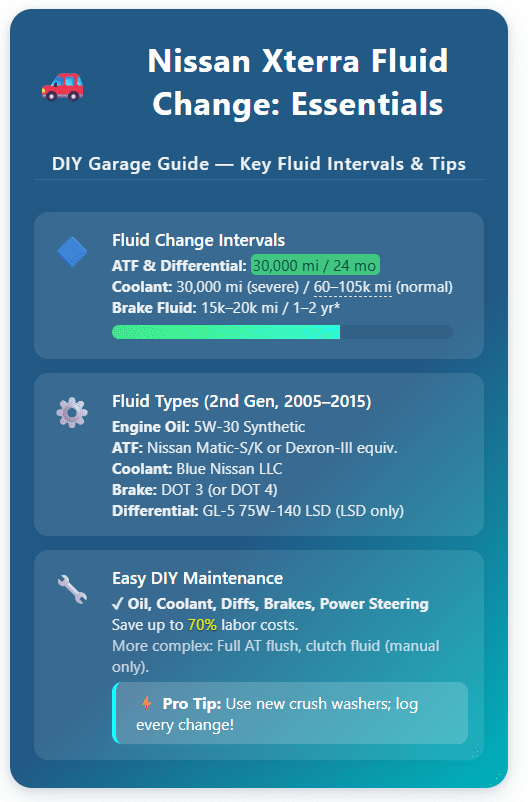
Severe service: every 30,000 miles or 24 months. For normal use, inspect regularly, but a change between 60,000–100,000 miles is still advised.
Brake fluid (every 1–2 years or 15k–20k miles) and ATF/differential fluids (every 30,000 miles or 24 months, especially for severe use).
Use high-quality synthetic 5W-30 API SN/GF-5 certified engine oil for all climates and both generations of Xterra.
Yes! Differential and transfer case fluid changes are excellent DIY jobs with basic tools. Use a fluid pump and always replace crush washers.
Look for dark or burnt ATF, noisy differentials, overheated or discolored coolant, dark or spongy brake fluid, and noisy power steering.
- Engine oil: 5W-30 synthetic
- ATF: Nissan Matic-S/K or Dexron-III equivalent
- Coolant: Nissan blue long-life
- Brake: DOT 3 (or DOT 4)
- Diff: GL-5 75W-140 LSD (LSD only)
Conclusion - Fluids, and when to replace them
Your Nissan Xterra was built to explore, to haul, and to last. By taking a proactive approach to fluid maintenance, you are making a direct investment in its longevity, reliability, and off-road capability. Ignoring these vital fluids is a gamble that can lead to the failure of your most expensive components, like the transmission or axles. By understanding the difference between normal and severe service, you can confidently adopt the more protective schedule that your Xterra deserves.
Don't be intimidated by the idea of "lifetime" fluids. Proactive maintenance is always the smarter path. Use this guide to arm yourself with the correct fluid types, capacities, and service intervals. Check your maintenance log or your odometer - is it time for a fluid change? Pick one service, like a front and rear differential fluid change, and get started. The satisfaction of doing the job yourself, combined with the peace of mind knowing your rig is protected, is one of the most rewarding parts of owning a capable vehicle like the Nissan Xterra.