Xterra Won't Start: Troubleshooting Guide
Systematic no-start diagnosis for all Nissan Xterra models (2000-2015): battery, starter, fuel pump and IPDM relays, crank/cam sensors, coils, and NATS.

One-tap dark, screen-awake, step-by-step reading for hands-on work.
Not sure this is the problem? Run the symptom diagnostic to compare likely causes.
Nissan Xterra Won't Start: Complete Troubleshooting Guide
There are few things more frustrating than turning the key in your ignition and getting nothing in return. Your Nissan Xterra, a rugged and capable SUV, is usually ready for any adventure, but when it refuses to start, it can bring your day to a screeching halt. Whether you're met with dead silence, a clicking sound, or an engine that cranks endlessly without firing up, a no-start condition can seem daunting.
Fortunately, most starting problems on the Nissan Xterra can be diagnosed with a systematic approach and some basic tools. You don't have to be a master mechanic to figure out what's wrong. By understanding the key systems - electrical, fuel, and ignition - you can methodically trace the problem to its source and get your Xterra back on the road.
This comprehensive guide will walk you through everything you need to know to troubleshoot and fix a Nissan Xterra that won't start. We'll cover common issues for both 1st generation (2000-2004) and 2nd generation (2005-2015) models, helping you pinpoint the exact cause based on the symptoms your vehicle is showing.
Initial Diagnostic Steps: What to Check First
Before you break out the full toolbox, start with the simple, high-probability culprits. A logical starting point can save you hours of unnecessary work. These initial checks will often reveal the root of your Nissan Xterra's starting problem without requiring deep technical knowledge.
Q: My Nissan Xterra won’t start - what should I check first?
A: Follow these five initial steps to quickly narrow down the problem:
- Battery & Connections: Check the battery voltage. A healthy battery should read at least 12.6V at rest. When cranking, it should not drop below 9.6V. Ensure the battery cables are tight and free of corrosion.
- Listen for the Fuel Pump: Turn the key to the "ON" position (without starting the engine). You should hear a faint 2-3 second hum from the rear of the vehicle. This is the fuel pump priming. No sound points to a fuel delivery issue.
- Check for Spark: If the engine cranks but won't start, an ignition problem is likely. You can perform a simple spark test by removing a spark plug, grounding it against the engine block, and having a helper crank the engine.
- Observe the Starter: Does the engine crank normally, crank slowly, or not crank at all? A slow crank points to a weak battery or failing starter. No crank at all suggests a dead battery, bad starter, or an issue with the ignition circuit.
- Scan for Codes: An OBD2 scanner is an invaluable tool. Look for codes like P0335 (Crankshaft Position Sensor) or P0340 (Camshaft Position Sensor), which are common no-start culprits.
Common Causes by Symptom
The specific symptoms your Xterra exhibits are your best clues. How it fails to start - whether it cranks, clicks, or does nothing - points you toward a specific system.
Engine Cranks but Won't Fire
This is a classic sign that you're missing one of the two essential ingredients: fuel or spark. The engine's mechanical parts are turning, but there's no combustion. Your investigation should focus on the fuel delivery and ignition systems. For 1st-gen models, this often leads to the distributor or coil pack, while 2nd-gen VQ40DE engines frequently point to faulty coil-on-plugs or crank/cam sensors.
Engine Doesn't Crank (No Click, No Sound)
If you turn the key and get complete silence, the problem is almost certainly electrical. Power isn't reaching the starter motor. This could be due to a completely dead battery, a failed starter solenoid, a faulty ignition switch, or a blown fuse/relay. On 2nd-gen Xterras, this is a hallmark symptom of a failed IPDM relay.
Engine Cranks Slowly or Weakly
A slow, labored crank is the most common symptom of a weak or dying battery. The battery may have enough voltage to power the lights but lacks the cold cranking amps (CCA) to turn the engine over effectively. This can also be caused by high resistance from corroded battery cables or a starter motor that is beginning to fail and drawing too much current.
Starts Intermittently
Intermittent starting problems are frustrating and often point to a loose connection or a component that is failing under certain conditions (like heat). Common causes include loose battery terminals, a failing fuel pump relay, a worn ignition switch, or failing crankshaft/camshaft position sensors that cut out when they get hot.
Deep Dive: Battery & Electrical System Diagnosis
The electrical system is the heart of your Xterra's starting process. A thorough check here is non-negotiable and often solves the problem quickly.
Battery Specifications by Generation
Using the correct battery is crucial. An underpowered battery will struggle to start the engine, especially in cold weather.
- 1st Gen Xterra (2000–2004): Typically uses a Group 96R battery with approximately 590 CCA.
- 2nd Gen Xterra (2005–2015): Requires a larger Group H6 battery with around 760 CCA to handle the more complex electronics.
Important: Always ensure your replacement battery meets or exceeds the original equipment manufacturer's (OEM) CCA rating. A simple voltage reading isn't enough; a battery can show 12V but fail under the heavy load of cranking.
Testing the Charging System
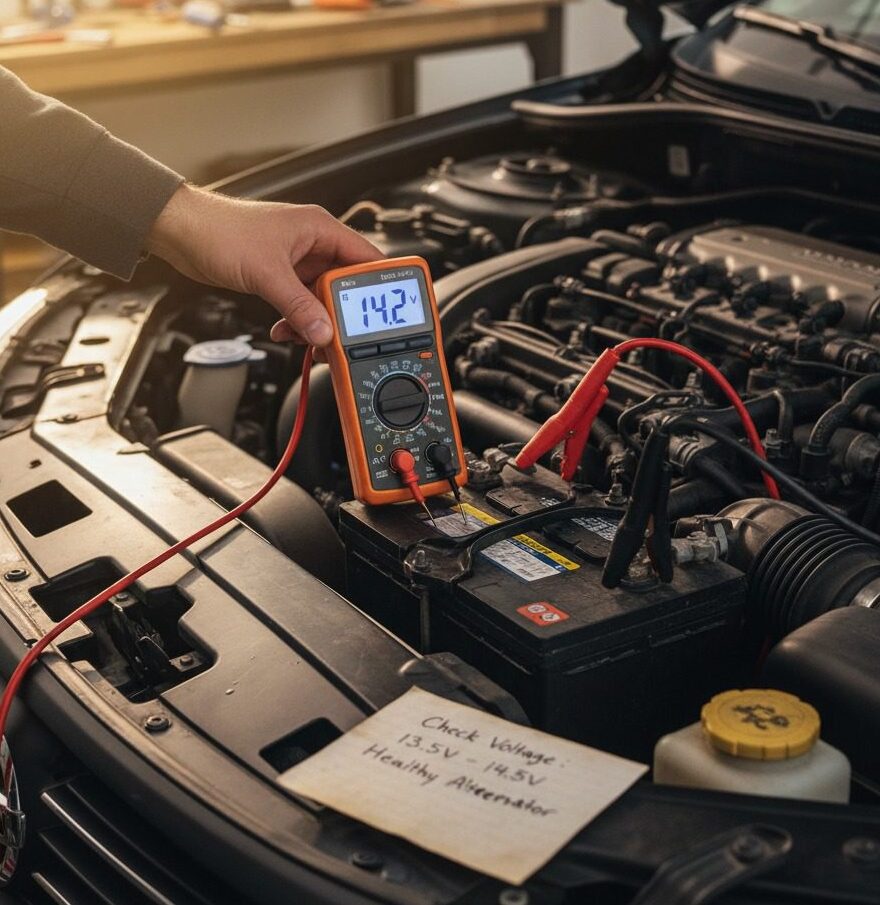
Your alternator keeps the battery charged while the engine is running. A faulty alternator will lead to a dead battery and a no-start situation.
- Check Voltage: With the engine running, use a multimeter to measure the voltage across the battery terminals. A healthy alternator should produce between 13.5V and 14.5V.
- Alternator Specs: 1st-gen Xterras are equipped with an ~80A alternator, while 2nd-gen models feature a more powerful ~130A unit.
Starter Motor and Cranking Tests
The starter is a powerful electric motor responsible for turning the engine over. If your battery is good but the engine won't crank, the starter or its circuit is the next place to look.
- Visual Inspection: Check that the main power cable and smaller signal wire on the starter are tight and clean. The starter is located on the passenger side of the engine block.
- Solenoid Tap Test: Sometimes, the starter solenoid can stick. A gentle but firm tap with a hammer or wrench handle can sometimes free it up for one last start. This is a temporary fix indicating the starter needs replacement.
- Bypass Test: For advanced users only. You can use a jumper wire to apply 12V directly to the starter's small "S" terminal. If the starter spins, the problem lies upstream in the ignition switch or relay.
Troubleshooting the Fuel System
If you've confirmed your electrical system is healthy and the engine cranks properly, it's time to verify it's getting fuel. A lack of fuel pressure is a common reason for a "crank, no-start" condition.
Checking Fuel Pump Operation
The easiest first step is to listen for the fuel pump. Turn the key to "ON" and listen for a 2-3 second hum from the back of the vehicle. If it's silent, your pump isn't getting power.
- Fuel Pump Relay Location:
- 1st Gen (2000-2004): The fuel pump relay is located in the interior fuse box, under the driver's side of the dashboard.
- 2nd Gen (2005-2015): The 15A fuel pump relay is in the fuse box inside the glove compartment, typically in slot #48.
How to Measure Fuel Pressure
Listening for the pump is a good start, but verifying pressure with a gauge is definitive.
- Connect a fuel pressure gauge to the Schrader valve on the engine's fuel rail.
- Turn the key to "ON" to let the pump prime the system.
- Check the reading against your model's specifications:
- 1st Gen (2.4L/3.3L): ~34 psi (235 kPa) at idle, and ~43 psi (294 kPa) with the vacuum line disconnected from the regulator.
- 2nd Gen (4.0L VQ40DE): A steady ~51 psi (350 kPa) at idle.
If pressure is low or zero, the fuel pump, relay, or filter is likely the culprit.
Fuel Injector and Filter Checks
If you have fuel pressure at the rail, you need to ensure it's reaching the cylinders. A clogged fuel filter can restrict flow, and failed injectors won't spray fuel. You can use a noid light to check for an electrical pulse at each injector connector while cranking. A blinking light confirms the engine computer is trying to fire the injectors.
Investigating the Ignition System
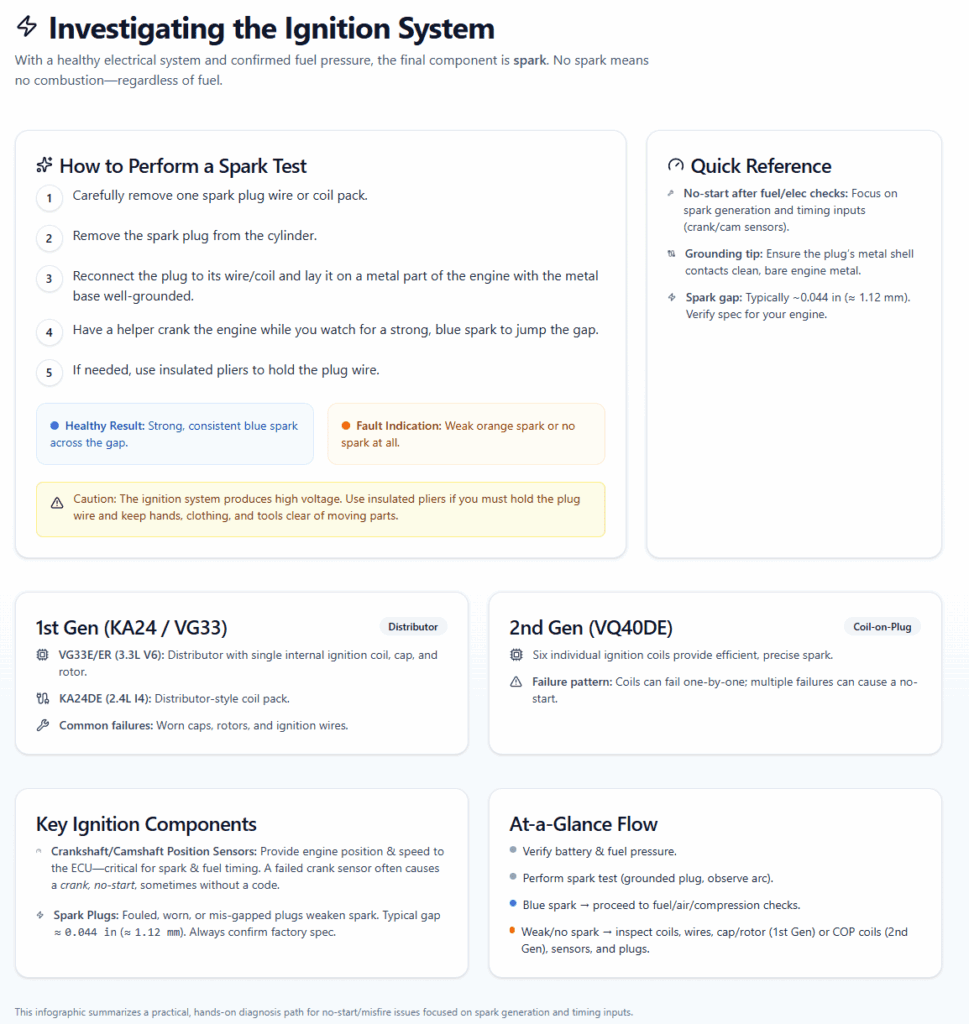
With a healthy electrical system and confirmed fuel pressure, the final component is spark. No spark means no combustion, regardless of how much fuel is present.
How to Perform a Spark Test
This simple test confirms if your ignition system is generating a spark.
- Carefully remove one spark plug wire or coil pack.
- Remove the spark plug from the cylinder.
- Reconnect the plug to its wire/coil and lay it on a metal part of the engine, ensuring the metal base of the plug is well-grounded.
- Have a helper crank the engine while you watch for a strong, blue spark to jump the gap.
- Caution: The ignition system produces high voltage. Use insulated pliers to hold the plug wire if necessary.
A weak orange spark or no spark at all indicates a problem within the ignition system.
Ignition Systems by Generation
- 1st Gen (KA24/VG33): These engines use a more traditional setup. The 3.3L V6 (VG33E/ER) has a distributor with a single internal ignition coil, cap, and rotor. The 2.4L 4-cylinder (KA24DE) uses a distributor-style coil pack. Worn caps, rotors, and ignition wires are common failure points.
- 2nd Gen (VQ40DE): This modern 4.0L V6 uses a coil-on-plug system with six individual ignition coils. While more efficient, these coils can fail one by one. A single failed coil will cause a misfire, but multiple failures can lead to a no-start condition.
Key Ignition Components to Inspect
- Crankshaft/Camshaft Position Sensors: These sensors tell the engine computer the engine's position and speed, which is critical for timing the spark and fuel injection. A failed crankshaft position sensor will almost always result in a "crank, no-start" situation, often without setting a trouble code.
- Spark Plugs: Fouled, worn, or incorrectly gapped spark plugs can prevent a strong spark. The recommended gap is typically around 0.044 inches.
Advanced Mechanical Checks
If you've confirmed you have good battery voltage, solid fuel pressure, and a strong spark, but the engine still won't start, it's time to consider a mechanical issue. These are less common but can be the root cause.
Performing a Compression Test
A compression test measures how well each cylinder can hold pressure.
A healthy gasoline engine should have compression readings between 130-180 psi, with less than 10% variation between the highest and lowest cylinders.
Very low compression in one or more cylinders indicates a serious internal problem, such as a bad valve, worn piston rings, or a blown head gasket, which will prevent the engine from starting.
Checking Timing and Valvetrain
All Nissan Xterra engines use a timing chain rather than a belt. While chains are durable, the guides and tensioners can wear out on high-mileage engines. A slipped or broken timing chain will throw off the synchronization between the crankshaft and camshafts, resulting in a no-start condition, often accompanied by a rattling noise from the front of the engine.
Common Xterra No-Start Issues by Generation
While the basic principles apply to all models, each generation has its well-known quirks and common failure points.
1st Gen Xterra (2000–2004) Common Problems
- Distributor Wear: The cap and rotor on the VG33E/ER V6 are wear items. Carbon tracking or cracks inside the cap can cause a no-spark condition.
- Fuel Pump Relay: The relay under the dash can sometimes fail, cutting power to the fuel pump.
- Crankshaft Position Sensor: Though reliable, a failure of this sensor on the timing cover will kill spark instantly.
2nd Gen Xterra (2005–2015) Common Problems
- IPDM Relay Failure: The Intelligent Power Distribution Module (IPDM) under the hood contains several critical relays. The ECM relay inside this module is a notorious failure point that causes a "crank, no-start" or "no-crank" issue. Nissan issued a recall for this part.
- Coil Pack Failure: The six coil-on-plug units on the VQ40DE engine can fail with age, leading to misfires or a complete no-start if multiple coils go bad.
- NATS Immobilizer: The Nissan Anti-Theft System (NATS) can prevent the engine from starting if it doesn't recognize the key. A solid or flashing security light on the dash when trying to start is a key indicator.
Essential Tools for DIY Diagnosis
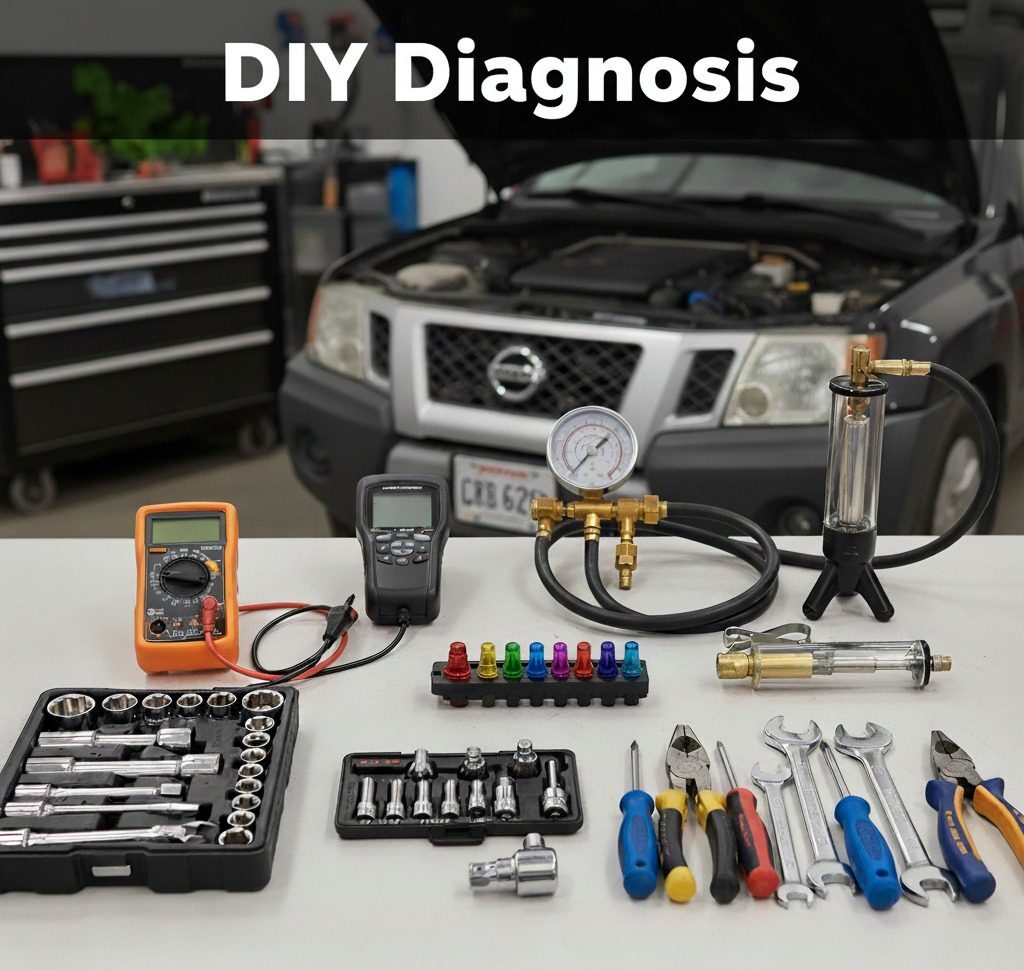
Having the right tools is half the battle. Here is a checklist of essential items for troubleshooting a no-start issue:
- Digital Multimeter: For checking voltage, resistance, and continuity.
- OBD2 Code Scanner: To read diagnostic trouble codes from the engine computer.
- Fuel Pressure Gauge: To accurately measure fuel pressure at the rail.
- Noid Light Set: To verify the fuel injectors are receiving a signal.
- Spark Tester: A safe and reliable way to check for spark.
- Compression Tester: For diagnosing internal engine health.
- Basic Hand Tools: A good socket set, wrenches, screwdrivers, and pliers.
Tips & Tricks for a Quick Diagnosis
Here are a few actionable tips that can speed up your troubleshooting process:
- The Relay Swap: If you suspect a relay is bad (like the fuel pump or starter relay), find an identical relay in the fuse box that controls a non-essential system (like the horn or A/C) and swap them. If the problem is solved, you've found your faulty relay.
- The "Spare Key" Test: If you suspect a NATS immobilizer issue, simply try starting the Xterra with a different registered key. If it starts, the problem is with your original key's transponder chip.
- Listen Carefully: Don't underestimate your ears. A single click often points to a starter solenoid, while rapid clicking indicates a low battery. The 2-second hum of the fuel pump is another critical audio clue.
- Clean Your Terminals: Before replacing a battery, give the terminals and cable ends a thorough cleaning with a wire brush and a mixture of baking soda and water. A layer of corrosion can create enough resistance to prevent a good connection.
FAQ - When the Xterra does not start
- Q: My Nissan Xterra won’t start - what should I check first?
-> A: Start by checking the battery voltage and connections, listen for the fuel pump, test for spark, observe the starter, and scan for diagnostic codes. - Q: The engine cranks but won’t fire. What does that mean?
-> A: This usually means you’re missing fuel or spark. Focus on checking the fuel delivery and ignition systems. - Q: I hear nothing when I turn the key. What is likely wrong?
-> A: Complete silence often points to an electrical issue like a dead battery, failed starter solenoid, faulty ignition switch, or blown fuse/relay. - Q: The engine cranks slowly. What could be causing this?
-> A: A weak or dying battery, corroded battery cables, or a failing starter motor are likely causes. - Q: My Xterra starts intermittently. What should I look for?
-> A: Check for loose connections, failing relays, worn ignition switches, or faulty crankshaft/camshaft sensors sensitive to heat. - Q: How do I test the alternator?
-> A: With the engine running, use a multimeter on the battery terminals. You should see between 13.5V and 14.5V. - Q: How do I check fuel pressure?
-> A: Connect a fuel pressure gauge to the rail, turn the key to “ON,” and compare the reading to your model’s specifications (e.g., 1st Gen: ~34-43 psi; 2nd Gen: ~51 psi at idle). - Q: How can I test if my ignition system is the problem?
-> A: Do a spark test by removing a spark plug, grounding it, and having someone crank the engine while you look for a blue spark. - Q: What are common no-start issues by Xterra generation?
-> A: 1st Gen: distributor wear, fuel pump relay, crankshaft sensor. 2nd Gen: IPDM relay failure, coil pack failure, NATS immobilizer issues. - Q: When should I call a professional?
-> A: Seek help if you find internal engine damage, suspect a faulty ECM or IPDM, face untraceable electrical shorts, or don’t feel confident doing the repair yourself.
When to Call a Professional
While many no-start issues are manageable for a DIYer, it's important to know your limits. You should seek professional help if:
- Diagnostics point to internal engine damage (low compression, failed timing chain).
- You suspect a faulty ECM or IPDM that requires specialized programming to replace.
- The problem is an intermittent electrical short that you can't trace.
- You simply don't have the time, tools, or confidence to tackle the repair safely.
Summary - What to do when the Xterra won't start?
A Nissan Xterra that won't start can be a major inconvenience, but it's a solvable problem. By following a logical diagnostic path - starting with the battery and electrical system, then moving to fuel and ignition - you can systematically eliminate potential causes and zero in on the faulty component. Remember to observe the symptoms carefully, as they provide the best clues for where to begin your search.
Start with the basics: ensure your battery is fully charged and the connections are clean and tight. Listen for the fuel pump and check for critical fuses and relays. If the simple fixes don't work, proceed with more detailed tests like measuring fuel pressure and verifying spark. With patience and the right approach, you can diagnose the issue yourself and make an informed decision about the repair. This methodical process will not only save you time and money but also empower you with a deeper understanding of how your vehicle works.